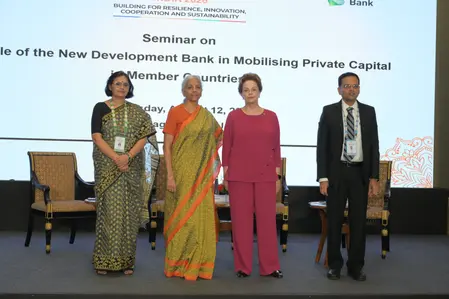
Finance Minister Nirmala Sitharaman on Wednesday said BRICS economies are major engines of global growth, but noted that member countries also face common structural constraints in mobilising private capital at scale.
BRICS Economies Show Growth Potential Amid Private Capital Challenges
The challenge is not merely the availability of capital, but the creation of confidence, stability, predictability, and credible long-term frameworks which are essential to unlock sustained private participation across member countries, the Finance Minister said in her keynote address at the seminar on “The Role of the New Development Bank in Mobilising Private Capital in Member Countries”.
Why multilateral banks matter for BRICS investment
She highlighted the critical role that the multilateral development banks play in de-risking investments, enhancing project bankability, and strengthening investor confidence so that private capital can be mobilised at scale.
The seminar was held on the sidelines of the BRICS Finance Ministers’ and Central Bank Governors Meeting, being hosted here under India’s chairship.
The Finance Minister emphasised that the future of development finance lies in partnership, multilateral institutions, national governments, and the private sector each bringing distinct strengths.
India’s infrastructure model focuses on public and private investment
Citing India’s experience, Sitharaman said that the Indian government has strengthened its infrastructure ecosystem through sustained public capital expenditure and complementary structural reforms. Public investment has expanded significantly compared to a decade ago, reflecting a deliberate strategy to create productive national assets across highways, railways, ports, logistics systems, digital infrastructure, and energy networks.


She stated that the government believes that public capital must act as a catalyst — not a substitute for private investment, and in support of this principle, it has carried out multiple reforms. These include viability gap funding (VGF) to support financially constrained but socially desirable projects; hybrid annuity model (HAM) to ensure balanced risk-sharing in road infrastructure, and credit enhancement mechanisms to improve project bankability.
InvITs and Budget 2026-27 measures to attract private capital
Besides, the setting up of Infrastructure Investment Trusts (InvITs) has helped to recycle capital and attract long-term institutional investors.
Building on this foundation, the Union Finance Minister informed that the Union Budget 2026-27 introduced several targeted measures to facilitate private sector investment, including new dedicated rail freight corridors, new high-speed rail corridors, operationalisation of new National Waterways, and a coastal cargo promotion scheme.
BRICS seeks stronger long-term investment frameworks
In her welcome address earlier, Secretary, Department of Economic Affairs, Anuradha Thakur stated that capital mobilisation cannot depend solely on favourable conditions; it must be anchored in frameworks that endure. Strengthening such frameworks is where multilateral collaboration can add lasting value.
The seminar brought together senior policymakers, multilateral institutions and private-sector leaders, and was followed by a deep-dive panel discussion with other representatives from BRICS countries, financial institutions, think tanks and academia.
Read More:
BRICS Women Working Group Meeting Begins in India to Advance Women-Led Development
BRICS Anti-Corruption Working Group agree on network proposed by India
FM Sitharaman Meets 86 PMIS Interns as Several Land Full-Time Jobs
India to Host BRICS Communications Ministers Meet on Resilient Digital Infrastructure
FM Sitharaman Highlights India’s Investor-Friendly Policies and Tax Certainty