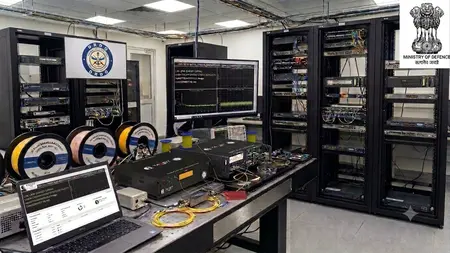
India has demonstrated its first free-space Quantum Key Distribution (QKD) link over a distance of 5.56 km, with a field trial successfully establishing a secure quantum communication channel between the Bhaskaracharya National Institute for Space Applications and Geo-informatics (BISAG-N) and IIT Gandhinagar.
India Demonstrates 5.56-km Free-Space QKD Link
The trial was conducted on the night of September 27-28 by QNu Labs in collaboration with BISAG-N and IIT Gandhinagar.
It used QNu Labs’ Pointing, Acquisition and Tracking system to maintain the free-space optical link and achieved a stable Quantum Bit Error Rate (QBER) below five per cent.
The system generated secure keys at a rate of 230-260 bits per second.
These keys were subsequently integrated with BISAG-N’s post-quantum cryptography-enabled Vedic Kavach platform, allowing successful end-to-end encryption and decryption of test messages.
Quantum Key Distribution Trial Achieves Stable Performance
The demonstration brought together two complementary approaches to quantum security.



QNu Labs’ hardware-based Armos QKD device was used over free-space optical channels, while Vedic Kavach provided software-based post-quantum cryptography along with quantum random number generation.
QKD and Post-Quantum Cryptography Combined
The integrated architecture is designed to remain resilient even when the physical quantum communication channel is temporarily unavailable.
Dr Vinay Thakur, Director General, BISAG-N, said the integration of Vedic Kavach with QNu Labs’ QKD technology marked “a significant step towards practical quantum-resilient communication systems”.
Sunil Gupta, Co-founder and CEO of QNu Labs, said: “The successful 5.56-km demonstration paved the way for longer-distance quantum-secure networks and satellite-based quantum communication.”
Cmde Manish Tripathi (Retd), In-charge, ISTF, IIT Gandhinagar, said the demonstration provided a valuable field environment for advancing practical quantum communication technologies.
“It showed how academia, indigenous technology and real-world experimentation could be integrated to address emerging secure communication requirements,” he added.
Free-Space QKD Could Support Satellite Communication
Free-space QKD transmits quantum signals through optical channels in open air rather than through fibre, making it a potential option for communication links where deploying fibre is challenging.
The technology also has potential applications in longer-distance and satellite-based quantum communication.
The trial provides a foundation for advancing India’s secure communication infrastructure and strengthening resilience against emerging quantum-era security threats.
India Strengthens Quantum-Secure Communication Capabilities
BISAG-N, an autonomous scientific society under the Ministry of Electronics and Information Technology, works in areas including space technology applications, satellite communication and geo-informatics, while IIT Gandhinagar, established in 2008, focuses on interdisciplinary research and education across engineering, science, technology, humanities and social sciences.
QNu Labs, founded in 2016, develops quantum-secure digital infrastructure and describes itself as a pioneer in sovereign quantum security products and solutions.
Read More:
Amaravati Quantum Valley building world-class quantum ecosystem: Chandrababu Naidu
India’s indigenous GSAT-7R satellite to bolster Navy’s communications successfully separated