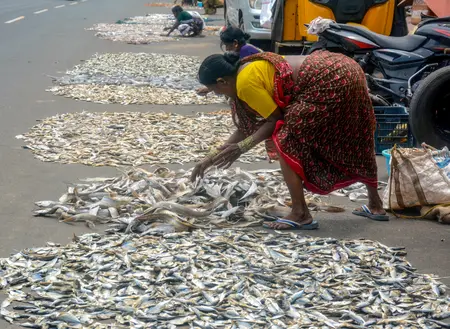
India’s fish production has more than doubled from 9.6 million tonnes in 2013–14 to 19.8 million tonnes in 2024–25, with inland production rising from 6.1 million tonnes to 14.74 million tonnes during the same period, according to a government factsheet released on Monday.
India’s fisheries sector sees major production growth
In order to safeguard this surge in production and protect farmers in the fisheries sector from disease, floods, and climatic variability, the Pradhan Mantri Matsya Kisan Samridhi Sah-Yojana’s (PM-MKSSY) insurance initiative, launched in 2024, has started serving as a structured framework of risk coverage.
The delivery is channelled through the National Fisheries Digital Platform (NFDP) ensuring benefits reach farmers directly through DBT.
PM-MKSSY offers insurance premium support
Four government-owned insurers are currently operational — OICL, AICL, NIAL, and UIIC — which offer coverage across shrimp, prawn, freshwater fish, and cold-water species, with private insurers onboarding also in progress to strengthen the insurance ecosystem.
Under PM-MKSSY, aquaculture insurance addresses the core barrier of affordability, wherein one-time monetary incentive is given to aquaculture farmers for purchasing aquaculture insurance policy through DBT for one crop cycle.
Under the scheme, an incentive up to 40 per cent of the insurance premium cost is provided to eligible beneficiaries. For pond-based aquaculture, the incentive is limited to Rs 25,000 per hectare of water spread area, subject to a maximum incentive of Rs 1,00,000 for up to 4 hectares, with farms having less than one hectare being eligible on a pro rata basis.
Insurance coverage expands across aquaculture systems
This has shown encouraging progress, with a total of 316 received so far, covering an area of 730.61 hectares. Out of these, 127 applications have been approved and disbursed, benefiting farmers over 321.74 hectares with a total disbursement of Rs 40.03 lakh.
For advanced aquaculture systems such as Cage Culture, Recirculatory Aquaculture Systems (RAS), Bio floc, Raceways and similar technologies, an incentive of 40 per cent of the insurance premium is provided, with a maximum incentive of Rs 1,00,000 and maximum eligible unit size of 1,800 cubic metres.
In addition, Scheduled Caste (SC), Scheduled Tribe (ST), and women beneficiaries are eligible for an additional incentive at 10 per cent of the incentive payable for the General Category.
How PM-MKSSY insurance claims are settled
In terms of claim settlement, in the event of occurrence of an insured peril, the beneficiary must immediately intimate the insurance company to initiate the claim process. The insured is required to submit documentary evidence as per policy terms, following which the insurance company appoints a loss assessor for evaluation of damages, according to the factsheet.
Based on the assessment report, the claim is processed, and payment is made to the insured, with periodic status updates provided through the insurer’s portal. The entire claim settlement process is to be completed within 30 days for shrimp culture and within 45 days for other aquaculture activities.
Government aims to build sustainable aquaculture insurance market
The government’s objective extends beyond subsidising premiums; it is to build a durable and self-sustaining market for aquaculture insurance. That will require a coherent and cooperative approach across all stakeholders: the Centre providing policy direction and digital architecture, States enabling outreach and field-level support, insurance companies designing and servicing credible products, farmers adopting risk protection as part of farm management, and technical institutions strengthening risk assessment, surveillance, and loss verification.
PM MKSSY itself envisages that these interventions will help create a robust market for aquaculture insurance products over time, said the factsheet.
Read More:
PMMSY scheme, gives booster shot to India’s fisheries sector
India Becomes World’s 2nd-Largest Fish Producer With 8% Global Output