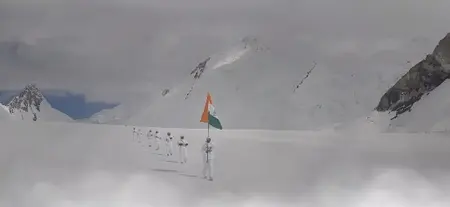
The Indian Army and the Indian Air Force on Monday saluted the indomitable courage, unwavering commitment, and supreme sacrifice of India’s brave soldiers defending the world’s highest battlefield. Operation Meghdoot remains a defining moment in Indian military history, marking India’s strategic control over the Siachen Glacier.
Operation Meghdoot 42 years of courage and sacrifice
As Operation Meghdoot completed 42 years, both forces paid tribute to a legacy defined by valour, endurance, and operational excellence in some of the harshest terrains and weather conditions on Earth.
Taking to the social media platform X, the Indian Army commemorated the occasion, marking April 13, 1984, as a historic day. It shared a tribute that read: “Quartered in snow, Silent to remain, When the clarion calls, They shall rise and march again.”
The Army also shared a video highlighting the significance of the operation, describing the extreme conditions under which soldiers continue to serve. It noted that at altitudes exceeding 20,000 feet, where survival itself is a constant challenge, Indian troops secured the highest battlefield on Earth on April 13, 1984, through Operation Meghdoot.
The visuals emphasised the soldiers’ “altitude of courage” and “steel spirit”, underscoring how every inch of territory is defended with determination and bravery.
Operation Meghdoot history and Siachen Day significance
Indian Air Force also took to social media ‘X’ and said, “On this Siachen Day, IAF salutes the indomitable courage, unwavering commitment and supreme sacrifice of our brave warriors defending the world’s highest battlefield.”




“As Operation Meghdoot completes 42 years, we honour the legacy of valour, endurance and operational excellence in the harshest of terrains and weather conditions,” the Indian Air Force added.
“From strategic airlift and logistics support, to casualty evacuation in extreme high-altitude conditions, the IAF continues to sustain operational readiness in the Siachen sector,” the Indian Air Force added.
April 13 marks Siachen Day, commemorating the Indian Army’s Operation Meghdoot in 1984. On this day, Indian troops landed at Bilafond La Pass and captured key positions on the Siachen Glacier, securing a strategic advantage in the disputed region of Kashmir, the world’s highest battlefield.
Why Operation Meghdoot is important for India
The poem “Quartered in snow, Silent to remain, When the clarion calls, They shall rise and march again” beautifully captures the spirit of the Indian Army’s presence in Siachen. It highlights the soldiers’ ability to remain vigilant and prepared, even in the harshest of conditions, and to respond swiftly when called upon to defend the nation.
Indian soldiers have been stationed in the harsh environment of the Siachen Glacier for decades, enduring extreme temperatures and challenging terrain.
The day marks the historic launch of Operation Meghdoot in 1984, when the Indian Army established full control over the Siachen Glacier, thwarting adversarial attempts to claim the strategically vital region.
Siachen has been a bone of contention between India and Pakistan ever since the Karachi Agreement of 1949, when the area was left undivided due to the hostile terrain and extremely rough weather.
Operation Meghdoot was India’s bold military response to what New Delhi calls Pakistan’s “cartographic aggression” in the uncharted territory of Ladakh, north of map reference NJ9842, where New Delhi and Islamabad had agreed the Line of Control (LoC) ran up to.
Intelligence inputs about impending Pakistani military action prompted India to secure strategic heights on Siachen, deploying troops via airlifts and air-dropping supplies to high-altitude airfields.
The primary objective behind Operation Meghdoot was to pre-empt the seizure of Sia La and Bilafond La passes by the Pakistan Army.
Launched on April 13, 1984, Operation Meghdoot was unique as the first assault launched on the world’s highest battlefield.
It was launched under the leadership of Lieutenant General Manohar Lal Chibber, Lieutenant General P.N. Hoon, and Major General Shiv Sharma.
It is distinguished by being one of the greatest examples of seamless coordination and synergy between the Indian Army and the Air Force.
The military action resulted in Indian troops gaining control of the entire Siachen Glacier.
Read More:
Indian Army, IIT Bombay formalise MoU for research, software
DRDO praised by IAF, Indian Army on its 68th Raising Day
Indian Army accelerates drone transformation: ‘Eagle in the Arm’ concept at core of modernisation
Assam Flood Indian Army Launches Operation Jal Rahat as Flood Situation Worsens