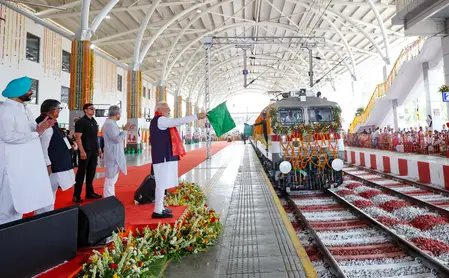
India becomes global leader with the largest electrified railway network, with 99.6 per cent electrification of its broad gauge network, Union Railway Minister Ashwini Vaishnaw informed the Lok Sabha on Wednesday.
The achievement places India ahead of major railway economies including China, Japan, France, Spain and the United Kingdom in terms of broad gauge railway electrification.
Why India becomes global leader with largest electrified railway network
India’s railway network electrification is ahead of China (82 per cent), Spain 67 (per cent), Japan (64 per cent), France (60 per cent) the United Kingdom (39 per cent).
Indian Railways accelerates electrification in mission mode
Indian Railways (IR) has undertaken one of the fastest railway electrification programmes in the world. While many countries prioritise electrifying only their busiest passenger and freight corridors, India has chosen to electrify its entire broad gauge network, the minister said in a written reply to a question in the Lower House.
Electrification of the track network on Indian Railways has been taken up in mission mode with a massive 48,072 route km being electrified between 2014-2026. This represents a sharp acceleration compared to the 21,801 route km that was electrified in the 60 years before this period, the minister stated.
Further, electrification of railway tracks reduces dependency on fossil fuels, decreased diesel consumption resulting in lower carbon emission. Electrification enables better haulage capacity and higher train speeds, leading to reduced travel time and enhanced efficiency.




Railway electrification cuts diesel use and carbon emissions
Reduction in IR’s diesel consumption for traction purpose by 185 crore litres with about 108 crore litres consumption in 2024-25 as compared to 293 crore litres in 2015-16. This has resulted in saving of precious foreign exchange, which would have otherwise been needed for import of fuel which has been saved due to electrification.
India’s diesel consumption for railway traction has also fallen sharply from 293 crore litres in 2015-16 to 108 crore litres in 2024-25, resulting in a saving of precious foreign exchange and a reduction in carbon emissions. Over 1,260 MW of solar and wind power capacity has also been commissioned to support low-carbon operations on Indian Railways. The expansion of the railway network promotes cleaner mobility, as rail transport emits about 89 per cent less carbon di-oxide than road transport, the minister further stated.
Renewable energy strengthens Indian Railways’ green transition
Electrified railways are well suited for integrating solar, wind and other renewable energy into traction power systems, making them most effective transport systems for utilizing renewable electricity. Indian Railways is committed to sustainable operations through near total Railway Electrification combined with use of renewable energy sources, based on strategic power procurement planning, thus contributing to carbon footprint reduction, the minister added.
Read More:
Indian Railways freight capacity target 3000 million tonnes by 2030 to drive growth
Providing good service for poor & middle class is top priority of Railways: Vaishnaw
India’s Indigenous Bullet Train Trials Set to Begin by May-June Next Year