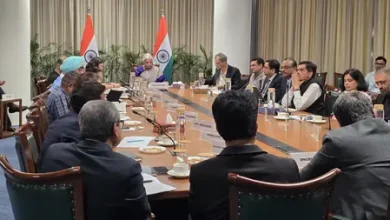

India and Nepal have signed a memorandum of understanding (MoU) to establish a Satellite Communication (SATCOM) Network using the South Asia Satellite. The agreement is intended to strengthen technical cooperation and expand the use of satellite-based communication services.
These were among the eight MOUs signed during Nepal Prime Minister Balen Shah’s current visit to New Delhi.
The MoU on the SATCOM network has been signed between Indian Space Research Organisation (ISRO) and the Government of Nepal.
India’s South Asia Satellite to Strengthen Nepal’s Communication Network
India has launched South Asia Satellite (SAS) to boost communication and improve disaster links among its six neighbours in the region. The satellite has been built by the Indian Space Research Organisation (ISRO) and funded entirely by India. The project cost nearly Rs 450 crore, with the satellite itself costing Rs 235 crore. The SAS is orbiting the Earth in its Geosynchronus Transfer Orbit (GTO).
The 2,230-kg communication spacecraft supports effective communication, broadcasting and Internet services in a region that is geographically challenging, economically lagging with limited technological resources.
The SAS or GSAT-9 is a geosynchronous communications and meteorology satellite. It will provide significant capability to each of the participating countries in terms of DTH (direct-to-home), besides linking the countries for disaster information transfer. It will help them in better governance, better banking and education in remote areas, more predictable weather forecasting and efficient natural resource mapping, linking people with top-end medical services through telemedicine and quick response to natural disasters. Its benefits also include deeper IT connectivity and fostering people-to-people contact.



The satellite has 12 Ku band transponders which the six nations can utilise to increase communications. Each South Asian country will get access to one transponder through which it will be able to beam its own programming, besides common “South Asian programming”. The countries will have to develop their own ground infrastructure. India is willing to extend assistance and knowhow.
The project cost India nearly Rs 450 crore, with the satellite itself costing Rs 235 crore. The SAS is orbiting the Earth in its Geosynchronus Transfer Orbit (GTO).
Read More:
ISRO Launches NVS-03 Satellite to Strengthen India’s Indigenous NavIC Navigation System
India, Nepal ink pacts for 2 JVs to set up cross-border power transmission lines