World Science Day for Peace and Development 2026: Balancing Human Progress, Ethics and Global Peace

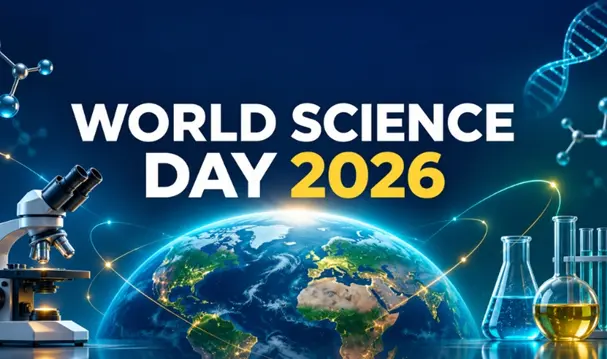
World Science Day for Peace and Development is celebrated every year on November 10 under the auspices of the United Nations Educational, Scientific and Cultural Organization (UNESCO). It was proclaimed by UNESCO in 2001 to highlight the importance of science in promoting global peace, social progress and sustainable development. The day emphasizes the need to use scientific knowledge, research and technological innovations to address major global challenges, including climate change, poverty, public health, food security and environmental degradation.
It also encourages cooperation among scientists, governments, educational institutions and international organizations to share knowledge and promote responsible scientific advancements. The 2026 theme focuses on “Common Ground Through Science Diplomacy,” highlighting how scientific cooperation can strengthen international relations, promote dialogue and build trust among nations. Ultimately, this day reminds the world that science should serve humanity, reduce inequalities and create a peaceful, prosperous and sustainable future for present and future generations.
World Science Day 2026: Science as a Driver of Human Progress and Global Peace
Science has been a powerful instrument of human progress, transforming healthcare, agriculture, education, communication, transportation and industrial development through research and technological innovation. According to the World Health Organization (WHO), vaccination programmes saved an estimated 154 million lives worldwide between 1974 and 2024, demonstrating science’s contribution to public health. Advances in artificial intelligence, biotechnology, space exploration, renewable energy and information technology have improved productivity, generated economic opportunities and addressed global challenges. The International Telecommunication Union (ITU) reported that 5.5 billion people, representing 68% of the world’s population, used the internet in 2024, expanding access to information and education.
However, the misuse of science has resulted in nuclear weapons, biological warfare, cybercrime, environmental pollution and advanced military technologies that threaten global security. According to SIPRI, nine nuclear-armed countries possessed approximately 12,241 nuclear warheads in January 2025. Furthermore, the World Meteorological Organization (WMO) reported that 2024 was the warmest year on record, with temperatures approximately 1.55°C above pre-industrial levels. Artificial intelligence, genetic engineering and digital surveillance also raise ethical concerns involving privacy, employment, human rights and inequality. Therefore, governments and scientists must strengthen ethical regulations, nuclear disarmament, environmental protection and international cooperation. Ultimately, science must promote human welfare, social responsibility, global peace and sustainable development.
The Future of Science: Human Development, Artificial Intelligence and Global Peace
Future scientific progress is expected to revolutionise human development through artificial intelligence, robotics, biotechnology, quantum computing, space exploration and advanced medical technologies, improving the quality of human life. Scientific innovations will contribute to early disease diagnosis, personalised healthcare, smart agriculture, modern education, clean energy and industrial productivity, helping nations achieve inclusive economic growth. According to the International Energy Agency (IEA), global renewable electricity capacity is projected to increase by approximately 4,600 GW between 2025 and 2030, creating opportunities for cleaner energy and environmental protection. The World Economic Forum’s Future of Jobs Report 2025 projects that technological, economic and other major transformations could create 170 million jobs and displace 92 million jobs by 2030, resulting in a net increase of 78 million jobs. However, excessive dependence on artificial intelligence and digital technologies may gradually weaken human natural thinking, independent decision-making, creativity, critical reasoning and problem-solving abilities if people rely on machines for every intellectual activity.
UNESCO has cautioned that excessive reliance on generative AI may undermine human agency and the development of intellectual skills, particularly among students and researchers. Furthermore, the misuse of scientific discoveries in nuclear weapons, autonomous warfare, cyberattacks and biological weapons could increase international conflicts and threaten global security. On the other hand, scientific cooperation among countries in medical research, climate change, disaster management, renewable energy and space exploration can strengthen diplomatic relationships, build mutual trust and promote peaceful coexistence. Therefore, governments, educational institutions, scientists and international organisations must establish ethical regulations, encourage independent human thinking, protect privacy and ensure that technological advancements remain under human control. Ultimately, science should empower human intelligence rather than replace natural thinking, promote cooperation rather than conflict, and become a foundation for global peace, human welfare and sustainable development.



India’s Role in Promoting Ethical Science and International Cooperation
India and the international community should adopt a comprehensive, ethical and human-centred scientific strategy to ensure that future technological advancements promote peace, prosperity and sustainable development. Governments must prioritise scientific research in healthcare, renewable energy, agriculture, environmental protection, education and disaster management while ensuring that the benefits reach all sections of society. Artificial intelligence, robotics and automation should complement human intelligence rather than weaken natural thinking, creativity, independent decision-making and problem-solving abilities, particularly among younger generations.
Strong international regulations must be established to prevent the misuse of scientific discoveries in nuclear weapons, biological warfare, cyberattacks and autonomous military technologies. Countries should strengthen science diplomacy through joint research programmes, technology sharing and cooperation in climate change, public health, food security and the peaceful management of natural resources. In this regard, UNESCO’s International Decade of Sciences for Sustainable Development (2024–2033) provides an important global framework for ensuring that science becomes a common instrument for human welfare, international cooperation and lasting peace.
Read More:
Andhra Pradesh signs MoU with NVIDIA for Artificial Intelligence University
India’s Renewable Energy Capacity to Reach 530 GW by 2030 IEA Report