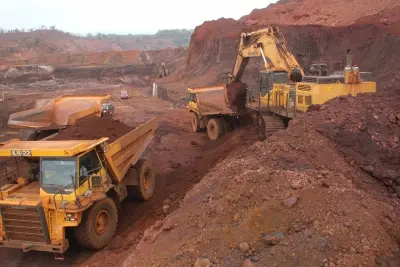
In a move to reduce wastage and promote utilisation of low-grade iron ore, the government has amended rules to revise pricing norms for such ore, the Ministry of Mines said on Tuesday. The low-grade iron ore utilisation push comes with revised pricing norms to support better resource use.
Low-grade iron ore utilisation and new pricing framework
The amendment provides a framework for pricing iron ore with iron (Fe) content below the threshold level of 45 per cent, including Banded Haematite Quartzite (BHQ) and Banded Haematite Jasper (BHJ), it said.
Under the revised rules, the average selling price (ASP) for iron ore, with 35 per cent to below 45 per cent Fe content, will be fixed at 75 per cent of the ASP of 45 per cent to below 51 per cent grade ore.
While for ore with Fe content below 35 per cent, the ASP will be 50 per cent of the same benchmark. These changes are aimed at improving low-grade iron ore utilisation by making pricing more viable.
Technology enables low-grade iron ore utilisation
Moreover, the threshold value refers to the minimum grade below which mined material is typically treated as waste.
However, with advancements in beneficiation technologies, low-grade iron ore, including BHQ and BHJ, can now be processed into usable high-grade material for steelmaking.

Prior to the amendment, there was no separate pricing mechanism for such low-grade ores.
As a result, the ASP of higher-grade ore (45–51 per cent Fe) was used for royalty and other levies, making beneficiation economically unviable, according to the government.
Low-grade iron ore utilisation to support steel industry
It further said that the new framework aims to correct this anomaly and incentivise the scientific and optimal utilisation of low-grade iron ore resources.
The government also noted that bringing such resources into the usable category will help address concerns over the depletion of high-grade reserves, ensure steady raw material supply to the steel industry, and support mineral conservation. The focus on low-grade iron ore utilisation is expected to strengthen raw material supply for steel production.
Royalty rules and economic value clarification
The amendment in the new framework has also clarified that in cases where processing of run-of-mine (ROM) ore leads to a reduction in its economic value, royalty will be levied on lumps and fines after initial screening of the unprocessed material.
The clarification ensures that the economic value of minerals is not artificially reduced under the guise of processing, the ministry said.
Read More:
Govt’s reforms have made India’s mining sector globally competitive: Kishan Reddy
Mining sector reforms a major step toward Viksit Bharat: G. Kishan Reddy
India clocks robust growth in key mineral production in FY25 first half