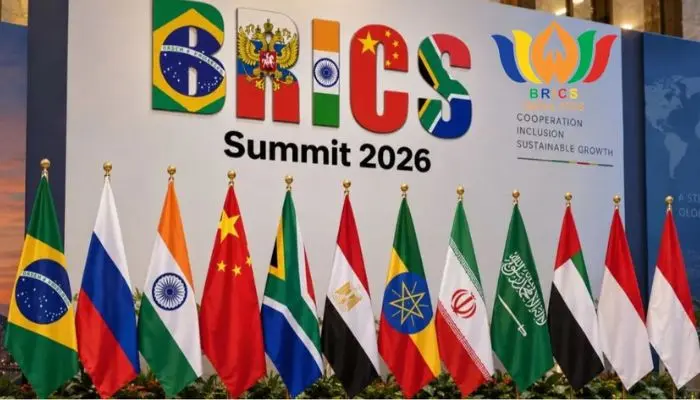
BRICS is an intergovernmental grouping promoting multilateral economic, technological and geopolitical cooperation among major emerging economies. Its objectives include reforming global economic and political governance, promoting a multipolar world order, expanding trade in local currencies and strengthening the collective voice of the Global South. Brazil, Russia, India, China and South Africa were the founding members, followed by Egypt, Ethiopia, Iran, Saudi Arabia, the UAE and Indonesia. The grouping has also institutionalised a partner-country model involving countries such as Belarus, Bolivia, Cuba, Kazakhstan, Malaysia, Nigeria, Thailand, Uganda, Uzbekistan and Vietnam.
Share in Global GDP
The expanded BRICS grouping has become a significant economic force, accounting for nearly 40% of global GDP and more than 45% of the world’s population. It represents around 22% of global merchandise exports, exceeding $5.6 trillion, and supports employment across manufacturing, agriculture, technology and energy. Customs cooperation, cross-border supply-chain facilitation, local-currency trade, infrastructure investment and financial cooperation through the New Development Bank (NDB) are strengthening economic connectivity. Despite differences in political systems and national interests, BRICS increasingly focuses on food and energy security, multilateralism, reform of international financial institutions and development priorities of the Global South.
BRICS New Delhi Declaration
Following negotiations to bridge geopolitical differences, the 18th BRICS Summit adopted the 140-point New Delhi Declaration unanimously. Emphasising resilience, innovation and cooperation, it adopted a zero-tolerance approach to terrorism, condemned cross-border terrorist networks and the Pahalgam attack, and called for reforms of the UN Security Council and Bretton Woods institutions to strengthen Global South representation. The declaration expressed concern over unilateral protectionism and tariff barriers and supported restoration of an effective WTO dispute-settlement system. On West Asian conflicts, it called for restraint, peace and humanitarian assistance. It also promoted sustainable development, digital public infrastructure and trustworthy AI. Thus, BRICS is seeking to expand beyond an economic grouping into a broader platform for cooperation on global governance, trade, technology, development and security.
Impact on Trade Rules
The declaration warned that unilateral tariffs and non-tariff measures could distort global trade and undermine WTO rules. It opposed discriminatory environmental trade barriers, particularly the European Union’s Carbon Border Adjustment Mechanism (CBAM), and called for restoration of the WTO’s two-tier dispute-settlement system and appointment of Appellate Body members. Instead of pursuing a single BRICS currency, it encouraged cross-border trade and investment in local currencies. This could reduce transaction costs, strengthen financial connectivity and provide greater flexibility in international payments.
Impact on United Nations Reforms
The declaration called for comprehensive UNSC reforms to make the institution more representative, democratic and accountable, with stronger and permanent representation for Africa, Asia and Latin America. It also supported greater transparency and inclusiveness in selecting senior international officials and noted that no woman has yet served as UN Secretary-General, calling for greater representation of women leaders from developing countries in the next selection process. It further criticised unilateral and secondary sanctions imposed outside the UN Charter framework, citing their potential implications for international law, human rights and development. The declaration therefore emphasised a rules-based multilateral system that better reflects Global South interests.
Role of the New Development Bank
Established in 2015, the New Development Bank (NDB) has an authorised capital of $100 billion to finance sustainable infrastructure and development projects in the Global South. BRICS is promoting national currencies and alternative financial arrangements, including initiatives such as the “BRICS Bridge”. The $100 billion Contingent Reserve Arrangement (CRA) is intended to provide liquidity support to members facing short-term balance-of-payments pressures. Together, these mechanisms aim to facilitate cross-border payments, reduce transaction costs and promote investment in energy, digital infrastructure and agriculture, contributing to a more resilient and multipolar financial system.



Common Currency
Although a common BRICS currency has been discussed at previous summits, the New Delhi Declaration indicated that such a currency is not currently being pursued, given differences in economic structures and monetary conditions. Instead, BRICS is focusing on bilateral trade in local currencies and interoperability among domestic digital payment systems. Special Rupee Vostro Accounts and alternative cross-border payment mechanisms could reduce foreign-exchange costs and mitigate some effects of financial sanctions. The participation of major energy exporters such as Saudi Arabia, the UAE and Iran also strengthen BRICS’ links with important emerging markets. Local-currency trade and institutions such as the NDB support the broader objective of financial resilience and a more multipolar international economic system.
Sustainable Development Goals
The New Delhi Declaration prioritises poverty eradication, food security, inclusive growth and implementation of the 2030 Sustainable Development Agenda. Recognising the continuing importance of fossil fuels for developing economies, it advocates a just, orderly and balanced energy transition. It opposed unilateral CBAMs as discriminatory trade barriers and supported the BRICS Carbon Markets Partnership, forest conservation and biodiversity protection. BRICS AGRIN promotes climate-resilient and regenerative agriculture and food security. The declaration also supports open-source digital public infrastructure and trustworthy, energy-efficient AI. In health, BRICS seeks to strengthen health training and mental-health networks and calls on developed countries to fulfil commitments relating to finance, technology transfer and capacity building. It also supports disaster-management systems, including early-warning mechanisms, and development-centred, people-centred approaches.
Artificial Intelligence Policy
The AI policy adopted at the BRICS New Delhi Summit on September 12–13, 2026, places AI at the centre of economic, scientific and technological cooperation. Members committed to implementing the BRICS Leaders’ Statement on Global AI Governance, with emphasis on wider access to AI resources for the Global South and safe, inclusive and trustworthy technologies. The policy addresses deepfakes, misinformation and AI misuse while promoting scientific innovation, green transformation and sustainable growth. It highlights AI energy efficiency, smart-grid integration, sovereign digital public infrastructure and domestic technological capabilities. Cooperation is also encouraged on intellectual property, training data, fair remuneration and cultural heritage protection. AI integration in healthcare, education and energy infrastructure is another priority.
Current Strategy
Amid geopolitical tensions, protectionist tariffs and financial sanctions, BRICS should strengthen economic resilience and strategic cooperation. It should accelerate local-currency payments and secure cross-border payment platforms while strengthening intra-BRICS supply chains through a Global Value Chains (GVC) Action Plan. The NDB can expand its lending capacity for development projects across the Global South, while members can work collectively for comprehensive WTO reforms and a stronger dispute-settlement mechanism. Cooperation in green technologies and compatible carbon-market mechanisms can address challenges associated with unilateral CBAMs. Shared digital public infrastructure and coordinated AI governance can strengthen technological capabilities and digital resilience. Permanent coordination mechanisms can improve policy continuity. Cooperation in energy security and critical minerals should also expand. At the same time, BRICS members can maintain constructive relations with major global powers while preserving strategic autonomy and diplomatic flexibility. Wider partnerships with developing economies can diversify markets, strengthen food and energy security, deepen development cooperation and contribute to a more multipolar global economic system.
Read More:
BRICS Takes Bigger Role in Shaping the New World Economic Order
PM Modi Says BRICS Summit to See Positive, Meaningful Discussions on Global Issues