” She did not merely sing songs. She gave voice to emotions, identities and generations, leaving behind a legacy that no silence can erase. ”
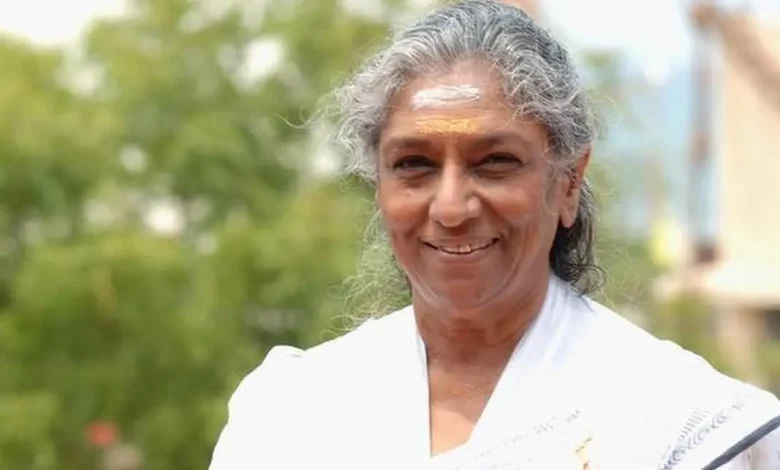
Some artists entertain their generation. A rare few define it. S. Janaki belonged to that rare league. Her passing is not simply the loss of one of India’s greatest playback singers; it marks the fading of a remarkable chapter in the history of Indian cinema. While voices eventually fall silent, the finest among them continue to resonate through memory, culture and time. Janaki’s belongs to that enduring category.
S. Janaki legacy transformed Indian playback singing
The history of Indian film music is inseparable from iconic voices that came to define entire eras. Ghantasala, Mohammed Rafi, Lata Mangeshkar, P. Susheela, Kishore Kumar and S. P. Balasubrahmanyam transformed playback singing into an art form. S. Janaki earned her place among these legends not because of the astonishing volume of songs she recorded, but because of an extraordinary ability to disappear into every character she sang for. Her voice rarely announced the singer; it revealed the soul of the person on screen.
How S. Janaki became the voice of generations?
Playback singing demands far more than technical excellence. A singer must become the unseen emotional presence behind an actor, making audiences believe that every word, every sigh and every silence genuinely belongs to the character. Few mastered this invisible art as completely as Janaki. With subtle shifts in tone and expression, she could sound like an innocent child, a playful young woman, a grieving mother or an ageing soul carrying decades of lived experience. Her voice never competed with the performance; it completed it.
That emotional intelligence distinguished her from many gifted contemporaries. Janaki understood that music is not created by melody alone. Meaning often resides in pauses, breathing, restraint and the delicate weight carried by every syllable. Her lullabies carried the warmth of motherhood, devotional songs conveyed quiet spirituality, romantic melodies felt intimate rather than theatrical, and songs of sorrow reached listeners with remarkable honesty. She sang not only with impeccable technique but with profound empathy.
S. Janaki’s journey from Andhra Pradesh to Indian music legend
Born in Pallapatla village of present-day Andhra Pradesh in 1938, Janaki entered cinema in 1957 and went on to sing thousands of songs in more than seventeen languages. Although estimates of her total recordings vary, she remains widely recognised as one of the most prolific playback singers in Indian film history. Even more remarkable was her effortless command over linguistic and cultural nuances. Audiences across Telugu, Tamil, Kannada and Malayalam cinema embraced her as one of their own—a distinction achieved by very few singers.



Her career also reminds us of an era when musical excellence depended primarily on artistic discipline. Recording studios offered little of the digital correction available today. Live orchestras, demanding rehearsals and near-flawless performances formed the backbone of film music production. Singers relied on years of rigorous training, precise diction, emotional control and musical instinct rather than technological refinement. That craftsmanship explains why so many songs from that generation continue to sound timeless.
Timeless collaborations with Ilaiyaraaja and S. P. Balasubrahmanyam
Janaki’s collaborations with composer Ilaiyaraaja elevated South Indian film music to extraordinary artistic heights. Her duets with S. P. Balasubrahmanyam remain deeply woven into the emotional memory of millions. Yet her greatness cannot be confined to a single composer, language or generation. She possessed the rare ability to evolve with changing musical trends while preserving the authenticity that made her voice instantly recognisable.
Her artistic integrity extended beyond music. In 2013, she declined the Padma Bhushan, expressing the view that South Indian artists often received national recognition too late or in insufficient measure. Opinions differed on her decision, but it reflected an artist who valued conviction above ceremonial honour.
Why S. Janaki’s legacy continues to inspire Indian cinema?
Janaki’s passing also invites a larger reflection on contemporary film music. Recording technology has advanced beyond imagination, expanding creative possibilities and making perfection easier to achieve. Yet one question continues to linger: can technology reproduce the emotional truth that artists like Janaki brought to a song? Technical polish can enhance sound, but it cannot manufacture emotional authenticity. That quality remains the defining measure of great music.
Awards tell only part of Janaki’s story. Four National Film Awards and numerous state honours acknowledge her remarkable achievements. Her true recognition, however, lives elsewhere in countless homes where her songs continue to accompany celebrations, comfort grief, evoke nostalgia and preserve memories across generations.
Artists leave the world; art refuses to do so. S. Janaki’s voice may no longer record new songs, but it will continue to echo wherever Indian cinema remembers its golden age. Some voices entertain. A few become history. The rarest become timeless. S. Janaki’s voice became an era.
Read More:
Legendary singer S Janaki dies at 88 after cardiac arrest in Mysuru
Baba Amte: A Flame of Service Ignited by a Child’s Heart