57th GST Council Meeting: Big Relief for Taxpayers as Centre Proposes Faster Refunds, Easier Registration

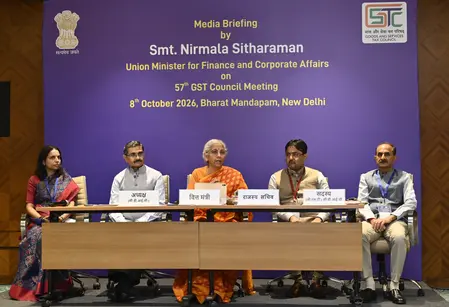
The 57th GST Council meeting has recommended a series of reforms covering GST registration, returns, refunds, input tax credit (ITC) and dispute resolution, aiming to improve the ease of doing business and make the tax framework more taxpayer-friendly. According to a government factsheet released on Saturday, the proposed measures seek to speed up administrative processes, reduce compliance burdens and create new opportunities for small sellers and service exporters.
57th GST Council Meeting and GST 2.0 Reforms
The GST 2.0 reforms come as registered taxpayers increased from around 60 lakh in 2017 to 1.70 crore (till September 2026).
As on September 30, the GST System had cumulatively processed 3,053 crore invoice uploads and 833.82 crore e-way bills. Gross GST collections reached Rs 12.46 lakh crore during April-September 2026, registering an increase of 11.6 per cent year-on-year.
GST Registration Rules: Automatic Approval and Easier Compliance
Now, for an easy and near real-time updation, the Council suggests automatic acceptance of amendments to registration particulars. This would be enabled on the portal, except for changes relating to the Principal Place of Business (PPoB). For taxpayers registered through the automatic route, amendments to all registration particulars, including PPoB, would be accepted automatically, according to the factsheet.
“The cancellation applications will be accepted automatically after pending returns are filed and all dues are paid. This would apply to taxpayers who have not passed on ITC exceeding Rs 2.5 lakh in any month. It would also apply where ITC exceeded Rs 2.5 lakh in a month, if the final return is filed within the specified time,” according to the statement.
GST Refunds: Faster Processing and 90% Provisional Refunds
The reforms suggested by the GST Council provide a simplified registration mechanism for small taxpayers making supply through E-commerce platforms.




Moreover, refunds of excess cash ledger balances would become automatic, facilitating faster availability of funds for businesses. The acknowledgement period would be reduced from 15 to 10 days. Deemed acknowledgement will apply where no response is issued.
Based on risk assessment, 90 per cent of claimed amount is expected to be sanctioned, for refund claims on account of zero-rated supplies and inverted duty structure, said the statement.
GST Penalties: Lower Fines and Relief in Small Tax Disputes
No show-cause notices will be issued if the tax amount involved is less than Rs 10,000. Pending notices on the date of the provision and appeals involving amounts below Rs 10,000, will be decided based on the Rs 10,000 minimum threshold, as if it were applicable when the notice was issued.
The penalty will be termed as ‘Charge’ in cases full tax amount is voluntary paid with interest and penalty, within the specified time limit.
A reduced penalty of 5 per cent will apply where tax and interest are discharged within 30 days (under section 73) or 60 days (under Section 74A) of the adjudication order.
The minimum penalty of Rs 10,000 is recommended to be removed, in non-fraud cases. The maximum general penalty would be reduced from Rs 25,000 to Rs 10,000. In cases where the order only involves penalty and no demand of tax, an upper limit of Rs 40 crore would be provided on account of pre-deposit for appeals before the Appellate Authority or Appellate Tribunal.
GST 2.0: Focus on Ease of Doing Business
These recommendations build on GST’s success and mark another step in its continued improvement. Together, these measures would further promote ease of doing business and contribute to a more efficient and taxpayer-friendly GST framework, said the factsheet.
Read More:
57th GST Council Meeting Begins in Delhi as Centre Pushes Next Phase of GST Reforms
States Welcome GST Reforms, Focus on Ease of Doing Business