The Indian Space Research Organisation (ISRO) on Friday launched NVS-03, India’s next-generation navigation satellite, aboard its Geosynchronous Satellite Launch Vehicle (GSLV-F18) rocket. The mission aims to strengthen the country’s indigenous Navigation with Indian Constellation (NavIC) system, India’s regional satellite-based navigation service.
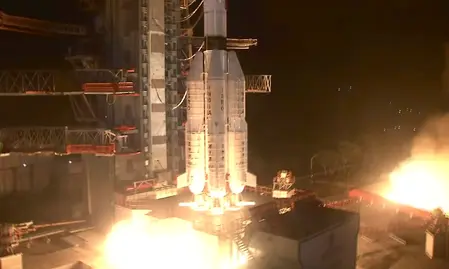
The launch took place at 11:51 pm at Satish Dhawan Space Centre in Sriharikota, Andhra Pradesh. “GSLV-F18 carrying NVS-03 lifts off from Satish Dhawan Space Centre, SHAR, Sriharikota,” India’s space agency ISRO said on X.
“Liftoff of GSLV-F18 carrying NVS-03 at 11:51 PM IST from Second Launch Pad, SHAR! ISRO’s rescue mission for NavIC is now underway,” it added.
The 50-metre-tall, three-stage GSLV-F18 rocket lifted off with the 2,232 kg NVS-03 satellite, aiming to deploy it into a Geosynchronous Transfer Orbit (GTO).
Once deployed, the satellite will perform orbit-raising manoeuvres to reach its final geosynchronous slot at 32.5 degrees East.
NVS-03 satellite to enhance India’s NavIC navigation system
NVS-03 is the third satellite of the second-generation NVS series, intended to augment the Navigation with Indian Constellation (NavIC) system, an indigenous GPS of sorts, and support the continuity of navigation services.




NVS-03 is designed to augment the NavIC constellation and ensure continuity of navigation services. The satellite carries an indigenous atomic clock along with procured atomic clocks. It also incorporates the L1 navigation signal in addition to the existing L5 and S signals, enhancing the system’s navigation capabilities.
What is NavIC, India’s indigenous navigation system?
“It also includes L1 signal in addition to existing L5/S signals with Coverage over India land mass and a region extending 1500 km around Indian geopolitical boundary,” said ISRO.
NavIC is India’s independent regional navigation satellite system, developed to provide accurate Position, Velocity and Timing (PVT) services to users across India and the region extending approximately 1,500 km beyond the Indian landmass.
ISRO plans five second-generation navigation satellites
According to ISRO, NavIC provides two types of services, the Standard Positioning Service (SPS) and the Restricted Service (RS). While SPS is intended for civilian users, RS is an encrypted service for authorised users.
ISRO has envisaged five second-generation navigation satellites to augment the existing NavIC constellation with enhanced features and ensure continuity of services.
Read More:
ISRO successfully launches EOS-05 aboard GSLV-F17 in major Earth observation mission
ISRO alone cannot meet India’s space needs says Chairman V Narayanan