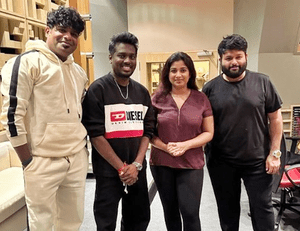
Tamil director Atlee who rose to immense fame with Shah Rukh Khan-starrer ‘Jawan’ has shared a picture of his another exciting collaboration with singer Shreya Ghoshal and music director Thaman S.
Taking to his photo-sharing platform, Atlee, who has two million followers on his Instagram, shared the snapshot on his Instagram Stories with renowned singer Shreya Ghoshal along with Telugu music director Thaman S and director Kalees.
Atlee captioned the picture, “Omg my fav singer for fav track in babyjohn”.
As per the background, it seems like the picture has been taken at a recording studio which also signifies that fans will soon be getting a major update on the upcoming action-thriller film.
It can be also speculated that the hint that Atlee has given can be either a romantic number from the film or it can be a power-packed party track for the film.
Later music director, Thaman S also took to his Instagram Stories and reshared the post of the ‘Mersal’ fame director.


He captioned the picture, “What a team. What a Film”.
Fans are now waiting to witness the first glimpse of Varun Dhawan starrer- ‘Baby John’ which is Atlee’s yet another big project in the Bollywood industry. However, he has not been in the director’s chair for this one but it can be considered as one of the biggest opportunities to produce big-budgeted films in Bollywood after his smashing success ‘Jawan’.
Apart from Varun Dhawan, Telugu actress Keerthy Suresh and Wamiqa Gabbi have also been roped in to feature in the Kalees directorial. Meanwhile, Superstar Salman Khan will also appear in the film in a special cameo appearance.
The upcoming action-thriller is bankrolled by Atlee, Murad Khetani and Jyoti Deshpande under the banner of A for Apple Productions, Cine1 Studios and Jio Studios in a joint venture.
The film will be released theatrically on December 25, 2024. The film is a remake of Thalapathy Vijay-starrer 2016 blockbuster ‘Theri’ alongside actresses Samantha Ruth Prabhu and Amy Jackson. The film’s music was composed by G.V. Prakash Kumar and bankrolled by Kalaipuli S. Thanu under the banner of V Creations.