Finance Minister Nirmala Sitharaman has explained how India successfully managed the West Asia crisis economic impact, enabling the country to remain the world’s fastest-growing major economy through strong domestic consumption, policy measures and expanding free trade partnerships. She highlighted India’s focus on conserving fuel, fertiliser and foreign exchange while maintaining economic stability during a period of global uncertainty.
Nirmala Sitharaman Explains India’s Response to West Asia Crisis Economic Impact
In an interview with leading French newspaper Le Figaro, Sitharaman said India successfully managed the economic fallout of the West Asia crisis that began on February 28 and continued to post strong economic growth while expanding global trade through free trade agreements (FTAs).
She told Fabrice Node-Langlois, Editor-in-Chief (Economics), that the free trade agreement signed between India and the European Union after prolonged negotiations would have a significant impact on global trade. She also emphasised that India’s growing middle class continues to be a major driver of domestic consumption and economic growth.
PM Modi’s ‘Three Fs’ Strategy Helped Protect the Economy
Referring to Prime Minister Narendra Modi’s appeal on May 10, Sitharaman said citizens were encouraged to avoid unnecessary international travel, postpone gold purchases for a year and reduce fuel consumption.
“I’ve taken to summarising the Prime Minister’s advice with a simple formula: preserve the three Fs — Fuel, Fertiliser and Foreign Exchange,” Sitharaman was quoted as saying.
She explained that all imports are paid for in foreign currency and that measures such as encouraging carpooling helped conserve India’s foreign exchange reserves.

The Finance Minister also noted that the government continued fertiliser subsidies despite higher costs.
“We haven’t increased the price paid by farmers, but this comes at a cost in foreign currency,” she said.
She further explained that although gold holds deep cultural significance in Indian households, the government urged families to postpone purchases because gold imports require valuable foreign exchange. The measures were intended to reduce pressure on India’s external account during heightened geopolitical uncertainty.
India and France Deepen Economic Cooperation
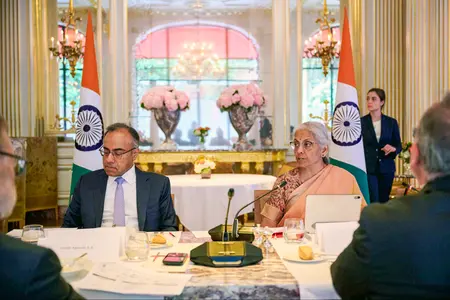
Meanwhile, India and France discussed expanding cooperation in critical minerals, economic sovereignty, security policies, and strengthening financial sector collaboration.
FM Sitharaman and Roland Lescure, France’s Minister of Economy, Finance, Industrial, Energy and Digital Sovereignty, co-chaired the India-France Economic and Financial Dialogue (EFD) in Aix-en-Provence.
According to an official statement, the dialogue reflected the growing importance of the India-France Strategic Partnership, with both countries focusing on high-level economic cooperation and practical, outcome-oriented solutions. The discussions are expected to further strengthen bilateral trade, investment and strategic economic ties between India and France.
Read More:
‘Viksit Bharat 2047’ and ‘France 2030’ provide strong convergences for innovation ties: Govt
Phone Banking During UPA Rule Led to Huge NPAs, Says FM Nirmala Sitharaman