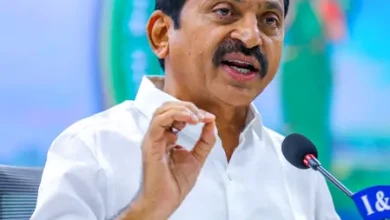
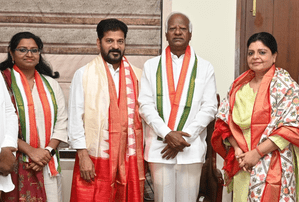
Former Telangana Deputy Chief Minister Kadiyam Srihari, one of the 10 BRS MLAs who defected to Congress last year, said on Sunday that if by-elections are to be held, he would not run away from them but would face them.
Stating that the matter related to 10 MLAs joining Congress was pending in the Supreme Court, he said he would abide by the court verdict.
“If by-elections are to be held, I will not run away. I will stay put to fight,” he told reporters.
The Telangana Assembly Secretary last week issued notices to 10 MLAs on the petitions of the Bharat Rashtra Samithi (BRS), seeking disqualification of the defectors.
This came after the Supreme Court asked the Telangana Assembly to define a “reasonable period” for a decision on the disqualification pleas.
The Supreme Court was hearing the petition of BRS MLA P. Kaushik Reddy seeking the disqualification of three MLAs Venkata Rao Tellam, Kadiyam Srihari, and Danam Nagender.

The next hearing on this petition is scheduled for February 10. The apex court will also take up for hearing another petition of BRS Working President K. T. Rama Rao, questioning the delay on the part of the Assembly Speaker in taking a decision on the disqualification of seven other defected MLAs.
Srihari said that the BRS has no right to talk about defections, alleging that it was the BRS that undermined democracy by engineering defections when it was in power. The senior leader alleged that there was no development in Telangana during the 10-year rule of the BRS.
The Dalit leader demanded that Scheduled Castes should be provided 18 per cent reservation in proportion to their population.
He alleged that BRS Working President Rama Rao was celebrating the BJP’s victory in the Delhi Assembly elections. He believes that Aam Aadmi Party (AAP) suffered defeat in Delhi polls due to its friendship with the BRS.
Srihari contended that if the Congress and the AAP had contested the Delhi elections together, they would have come to power.
In March last year, Kadiyam Srihari along with his daughter Kadiyam Kavya joined the Congress.
Kavya was declared the BRS candidate for the Lok Sabha elections from Warangal. She was elected to Lok Sabha from the same seat as the Congress candidate.
Srihari was elected to the Assembly from Station Ghanpur constituency in 2023.
Srihari, a prominent SC leader who had started his political journey in the 1980s with the Telugu Desam Party (TDP), had also served as a minister in the cabinets of N. T. Rama Rao and Chandrababu Naidu in combined Andhra Pradesh. He had also served as TDP General Secretary and Politburo member.
A four-time MLA from Station Ghanpur in Warangal district, he joined the TRS (now the BRS) in 2013.
He was elected to Lok Sabha from Warangal on a TRS ticket in 2014 but the next year BRS President and then Chief Minister K. Chandrasekhar Rao inducted him into the Cabinet as Deputy Chief Minister and Education Minister.