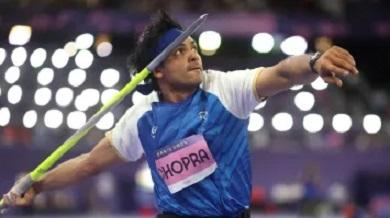
India’s two-time Olympic medallist and reigning World Champion in javelin throw, Neeraj Chopra, will participate in his first Diamond League meet of the season in Doha, Qatar, on Friday, hoping to make a winning start in the event in which he has won the final.
On the back of his mind will also be the elusive 90m mark as Neeraj, who won India’s first Olympic gold medal in track and field in Tokyo and followed it up with a silver in Paris in 2025, prepares for his first full season under his new coach Jan Zelezny—a three-time Olympic gold medallist and world record holder.
This shift follows a successful four-year stint with biomechanics expert Dr. Klaus Bartonietz, under whom Chopra won both his Olympic and World Championship titles.
Neeraj will be hoping to give his best in Doha as he will have a break after that because of the cancellation of the NC Classic 2025, which he was organising in association with World Athletics and the Athletics Federation of India in Bengaluru on May 24.
So, Doha will his first big meet of the month where he will face top stars like two-time world champion and 2024 Olympics bronze-winner Anderson Peters of Grenada, Jakub Vadlejch of Czechia, who won here in 2024, the German duo of Julian Weber and Max Dehning, Kenya’s Julius Yego and Roderick Genki Dean of Japan.
Reigning Olympic gold medal winner Pakistan’s Arshad Nadeem won’t be a part of this tournament as he preparing to participate in the Asian Athletics Championships in Korea.
Also participating in javelin throw will be Asian Games silver medallist Kishore Kumar Jena, while National Record holder Gulveer Singh will be in the fray in Men’s 5000m, while Parul Chaudhary will be taking part in women’s 3000m steeplechase.
When and Where to Watch:
What: Neeraj Chopra’s javelin throw event at the Doha Diamond League
When: Friday, May 16, 2025.
Timing: Neeraj Chopra’s Javelin Throw event at the Doha Diamond League will begin at 10.13 PM IST.
Where to watch: It will not be broadcast on television but will be streamed live on the Wanda Diamond League YouTube channel and Facebook page.