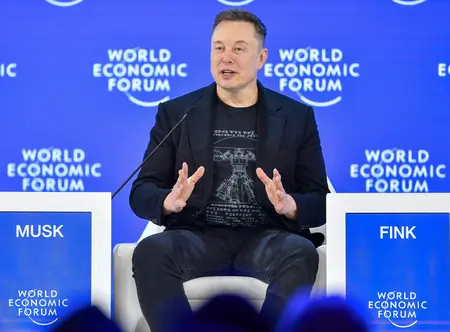
Elon Musk has warned G20 economies of a looming AI power crunch, saying the world could face a significant electricity shortage as early as next year as the production of AI chips races ahead of energy capacity.
Elon Musk Warns G20 of AI Power Crunch
“There will be a significant power shortfall next year, so not like the distant future,” Musk told a G20 session on emerging technologies.
Musk, the chief executive of Tesla and SpaceX, said analysts closely following the sector expected “at least a 15 gigawatt shortfall of power in 2027 for AI chips”.
He said the production of AI chips was rising by about 40 to 50 per cent annually, while available power outside China was increasing by only 10 to 20 per cent a year.
“So obviously the faster rising thing will eventually overwhelm the slower rising thing,” Musk said.
Countries with more power could attract AI investment
His remarks came as G20 members reached consensus on the Carolina principles for emerging technology. The principles are intended to provide a policy framework under which new technologies can be developed and deployed while supporting economic growth.

Musk said countries capable of rapidly expanding electricity generation could attract major AI investments.
“This creates an opportunity, I think, for countries around the world, if they’re interested in AI data centres, to construct a lot of power and offer that to AI companies,” he said.
Such data centres would generate tax revenue and pay fees to host countries, he added.
Musk predicts massive AI economic impact
Musk said AI could increase the global economy by 20 to 30 per cent, or about USD 20 trillion to USD 30 trillion annually. He predicted that AI would soon outperform humans in software development and become highly capable across engineering and other digital fields.
“At some point next year is my prediction, software will be so good, AI software will be so good that it will be Stockfish-level good, meaning that it is impossible for a human to compete in writing software with AI,” he said.
Stockfish is a chess programme capable of defeating the world’s strongest players.
Humanoid robots could reshape global productivity
Musk also forecast even greater economic changes from humanoid robots. He said robots would eventually begin manufacturing other robots, producing what he described as a recursive effect that would initially develop slowly before expanding rapidly.
“If you say like 10 years from now, I would say there are well over a billion humanoid robots,” Musk said.
He estimated that each robot could produce five times the output of a human worker. “The billion humanoid robots will be more productive than all humans combined,” he said.
Musk calls for lighter technology regulation
Musk urged governments to establish regulatory systems that allow new technologies to be introduced without requiring advance permission. He contrasted that approach with the European Union, where he said high regulation slowed technological progress.
“New things must be default legal as opposed to default illegal,” he said.
He also called on governments to focus support on start-ups rather than established corporations. Comparing companies to trees in a forest, Musk said large businesses often had direct access to national leaders while young companies did not.
“The system should be generally biased towards supporting the small trees as opposed to the large ones,” he said.
The Group of 20 brings together 19 countries, the European Union and the African Union. Its members account for most of the world’s economic output, international trade and population.
Read More:
AI data centres in India attract billions as global tech giants expand investments
Elon Musk Says Starlink Would Help India’s Least-Served Rural Areas