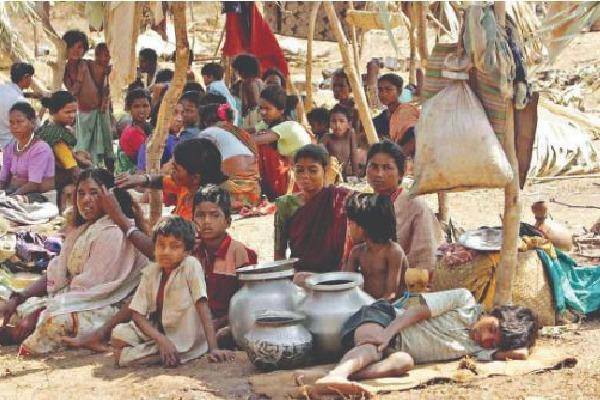
Poverty is the most severe challenge globally, acting as a major impediment to human development. It signifies not merely a lack of sufficient money, but also the denial of basic human rights and opportunities such as healthcare, education, clean water, and the freedom to make decisions. According to Nobel Laureate Amartya Sen, poverty is ‘capability deprivation,’ a complex socio-economic ailment that prevents marginalized people from reaching their full potential. Broadly, poverty can be classified as absolute poverty—a condition where minimum subsistence needs are not met—and relative poverty—a state of earning an income below the average level of society. However, today’s multidimensional poverty metrics clearly reveal the greater depth of the problem.
*The Government and the State of Poverty in India:
Despite global progress in poverty eradication, the goal of eliminating extreme poverty by 2030, a key Sustainable Development Goal, has been challenged by the COVID-19 pandemic and international economic uncertainties. The World Bank defines the international extreme poverty line as an income of less than $2.15 per day. Reports from the 2024 Multidimensional Poverty Index indicate that over 1.1 billion people worldwide face multidimensional deprivations related to health, education, and living standards.
Regarding India, the country has made extraordinary progress in poverty eradication over the past decade. An analysis of World Bank reports shows that extreme poverty in the country significantly decreased from 27.1% to 5.3% between 2011-12 and 2022-23. In this historic period, approximately 270 million people escaped severe poverty. This decline, recorded at 2.8% in rural areas and 1.1% in urban areas, indicates the effective implementation of government policies, especially the expansion of infrastructural welfare schemes. The National Multidimensional Poverty Index released by NITI Aayog corroborates this, stating that crores of people have escaped poverty due to improvements in areas like the Ujjwala Yojana and Pradhan Mantri Awas Yojana. Institutions like the Brookings Institution have even declared that, based on consumption expenditure data, India has officially eliminated extreme poverty, showcasing the country’s progress internationally.
*Major Factors – Systemic Roots
Poverty is not caused by a single factor but is a confluence of several systemic socio economic issues. One of the main reasons for poverty is the unequal distribution of wealth and income. Despite economic growth, its benefits reaching only the affluent sections of society widens the poverty gap. These inequalities are exacerbated by unemployment and a lack of job opportunities. Over-reliance on the agricultural sector in rural areas and low wages and a lack of social security in the informal sector in urban areas perpetuate the cycle of poverty. Furthermore, the lack of quality education and healthcare acts as a systemic root of poverty. Illiteracy and incomplete education prevent workers from securing high-wage jobs. Simultaneously, when poor families fall ill, they must borrow heavily for treatment, plunging them further into a debt trap. Additionally, high population growth puts pressure on limited resources, social and gender discrimination denies opportunities, and corruption and leakages in the implementation of government welfare schemes also sustain poverty.


*Challenges and HurdlesEradicating poverty: fundamentally faces several structural challenges. The most important is breaking the ‘poverty trap,’ a cycle where low income, poor health, and low education continue across generations, preventing the family from ever improving. The second major challenge is the impact of climate change. Natural disasters like unseasonal rains, droughts, and floods instantly destroy the livelihoods of agriculture dependent poor people, pushing them back into extreme poverty. The third challenge is the risk of unskilled workers losing jobs due to rapid technological change. The poor who cannot upgrade their skills to match these changes fall behind in the competitive world. The fourth challenge is the concentration of poverty and resource scarcity in urban slums due to increasing rural-to-urban migration. These challenges complicate the implementation of unilateral policies aimed at poverty eradication and emphasize the need for multidimensional, sustainable strategies.
*Central Government’s Comprehensive Strategies and Policies:
Welfare assistance alone is insufficient to address poverty. It requires a balanced combination of economic growth, human capital investment, and systemic reforms. Firstly, guaranteeing access to quality education and health for every citizen is essential, as these are the biggest solutions to breaking the poverty cycle. Secondly, creating productive and sustainable employment opportunities in non-agricultural sectors, especially manufacturing and services, is crucial. Supporting Micro, Small, and Medium Enterprises and promoting entrepreneurship are key to this.
To achieve these goals, the Central Government is implementing several policies. Focusing on employment and economic empowerment, the Mahatma Gandhi National Rural Employment Guarantee Scheme (MGNREGS) provides a right to minimum wage employment for the rural poor. The Deendayal Antyodaya Yojana – National Rural Livelihoods Mission (DAY-NRLM) supports women’s Self-Help Groups (SHGs), empowering them economically. For social security and financial inclusion, the Pradhan Mantri Jan-Dhan Yojana brings people into the banking system, allowing for the direct transfer of scheme benefits without leakages through Direct Benefit Transfer (DBT). Schemes like the Pradhan Mantri Awas Yojana, Ujjwala Yojana, and Swachh Bharat Mission play a vital role in reducing multidimensional poverty by providing better housing, clean fuel, and sanitation to the poor.
*Steps Towards Sustainable Development:
Poverty is not just an economic indicator; it is a humanitarian crisis reflecting the injustice and inequality within society. India’s recent successes in poverty reduction, targeted policies, and technology driven governance clearly demonstrate the power of these efforts. However, the biggest challenge ahead is sustaining this progress and ensuring that benefits reach even the most marginalized segments of the population. Only when poverty is completely eradicated can India achieve true economic and social justice and secure its place on the world stage as a developed nation. Collective participation from governments, civil society, and the public is essential in this endeavor.