
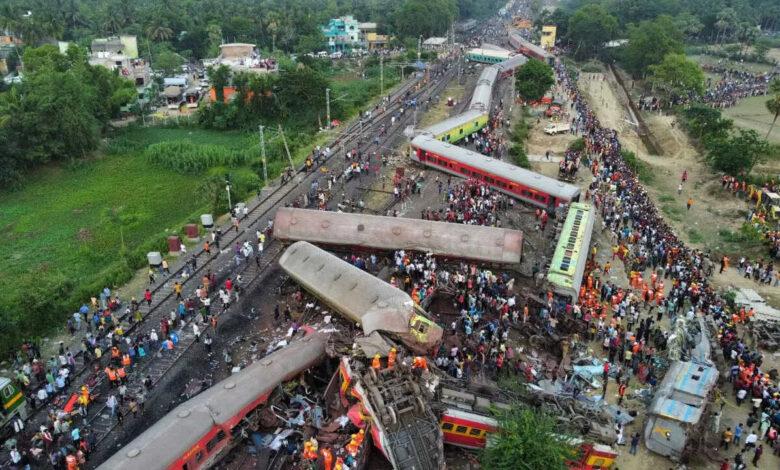
Despite substantial government funding and safety initiatives, concerns regarding railway track safety persist in India. This isn’t primarily due to a lack of resources, but rather a troubling combination of human error, official negligence, and maintenance shortcomings. The tragic train accident on July 8, 2025, at Semmankuppam in Cuddalore district, starkly underscores this reality. A speeding Villupuram-Mayiladuthurai passenger train collided with a private school van, claiming the lives of three students and raising serious questions about railway safety protocols, human accountability, infrastructure, and systemic failures.
The Cuddalore Tragedy: Causes and Lingering Questions:
The accident at Railway Level Crossing Gate No. 170 in Semmankuppam, Cuddalore district, occurred around 7:45 AM on July 8, 2025. This was a manually operated, non-interlocked gate. A private school van was crossing the tracks when it was struck by Villupuram-Mayiladuthurai Passenger Train (No. 56813). The devastating incident resulted in the deaths of three students and injuries to the van driver, Shankar. A local resident who rushed to help also suffered an electric shock and was hospitalized.
Conflicting narratives have emerged regarding the cause of the accident. Eyewitnesses, injured student Visvesh, and van driver Shankar alleged that the railway gate was open and no train horn was sounded. They explicitly stated that the gatekeeper, Pankaj Sharma, was asleep on duty and failed to close the gate. However, Southern Railway initially claimed that the gatekeeper attempted to close the gate, but the van driver insisted on opening it, a violation of established rules. They also highlighted that this was a “non-interlocked gate,” meaning manual operation was required. Some also pointed to the gatekeeper’s inability to speak Tamil as a contributing factor, advocating for local language speakers in such critical positions. Furthermore, Southern Railway revealed that despite funds being sanctioned for an underpass construction, approval from the Cuddalore district administration had been pending for a year. This incident appears to be a confluence of human error, disregard for safety protocols, infrastructure deficiencies, and inadequate oversight of school transportation.
Persistent Gaps in Railway Safety:
Such accidents are not new. We recall the horrifying incident on July 24, 2014, when a school bus collided with a train at an unmanned level crossing in Masaipet, Medak district, Telangana, killing 16 students. The Cuddalore incident is another grim reminder of human negligence and safety lapses. Despite continuous efforts by Indian Railways, several critical gaps in level crossing safety persist.



Over-reliance on human vigilance is a primary concern. Fatigue, negligence, and inadequate training among operators of manually controlled gates often lead to accidents. The slow pace of level crossing elimination is another major issue. While most unmanned crossings on broad gauge lines have been removed, the construction of Railway Over Bridges (ROBs) and Railway Under Bridges (RUBs) is hampered by land acquisition and inter-departmental coordination problems. Many gates, like the one in Cuddalore, remain “non-interlocked,” meaning the gate operation isn’t electronically integrated with the train signaling system. This allows for the possibility of a green signal being given to a train even before the gate is fully closed. A lack of oversight and communication issues also contribute to negligence-related accidents. Technologies like Kavach (Automatic Train Protection System) are being implemented, but their widespread deployment is still incomplete.
A Way Forward: A Comprehensive Action Plan
Preventing such accidents demands a multi-pronged strategy focusing on technology, infrastructure, human resource development, and public awareness.
Immediate and Short-Term Measures (0-6 months):
* Immediate Suspension and Investigation: Swiftly suspend negligent personnel and initiate fast-tracked, transparent inquiries.
* Comprehensive Safety Audits: Conduct thorough safety inspections across all manned level crossings nationwide, particularly in high-risk areas.
* Enhanced Surveillance: Accelerate the installation of CCTV cameras, especially at accident-prone locations.
* Refresher Training: Inspect voice logger system functionality and provide immediate refresher training to all gatekeepers and supervisory staff.
* Expedited Approvals: Coordinate with local administrations to fast-track approvals for pending overbridge and underbridge projects.
* School Transport Checks: Conduct immediate and stringent safety checks on all school transportation vehicles.
Medium-Term Measures (6 months – 2 years):
* Interlocking All Manned Crossings: Integrate all remaining manned level crossings with an interlocked system.
* Prioritize Conversion: Prioritize the conversion of high-traffic and high-risk level crossings.
* Advanced Warning Systems: Implement advanced sensor-based warning systems.
* Automated Gate Closures: Explore the implementation of automated gate closure systems at the most critical level crossings to reduce reliance on manual operation.
* Centralized Monitoring: Develop a centralized digital platform for real-time monitoring of all level crossings.
Long-Term Measures (2+ years):
* Total Elimination: Work towards the ultimate goal of completely eliminating all level crossings on major routes.
* Kavach Integration: Integrate level crossing safety mechanisms into the broader Kavach system, where trains automatically receive warnings and reduce speed if a crossing is not clear.
* Research & Development: Invest in R&D for innovative safety solutions, including predictive analytics, advanced materials for infrastructure, and more.
* Robust Safety Culture: Foster a strong safety culture at all levels of Indian Railways, where safety is paramount, and every employee is empowered and accountable for upholding safety standards.
* Continuous Public Awareness: Implement continuous and effective public awareness campaigns using various media channels to instill a strong sense of responsibility and caution among road users at railway crossings, highlighting the real and devastating consequences of safety lapses and combating the “it won’t happen to me” mentality.
The Role of Technology: Unlocking Its Full Potential:
Currently available and evolving technologies can significantly reduce level crossing accidents, but their full potential remains untapped. The Kavach system, designed to prevent train collisions and signal passing at danger, can be extended to level crossings. Predictive analytics and artificial intelligence can anticipate accident scenarios, while drone surveillance can facilitate inspections in remote areas. Advanced sensor technology can detect obstacles and vehicles on tracks, and automatic number plate recognition can identify vehicles violating regulations. However, barriers to widespread deployment include high investment costs, integration with older railway systems, a shortage of skilled personnel, and lengthy procurement processes.
Addressing the “Last Mile” Problem in Safety:
A “safety-first” culture must be fostered, where every employee is empowered to halt operations if they identify a safety risk. Community participation can engage local communities in safety initiatives, helping to change attitudes towards railway crossing safety.
Legal and Regulatory Framework Improvements:
While a legal framework exists, its implementation and adaptability must be continuously reviewed. Stricter penalties should be imposed for violations at level crossings, particularly for road users who disregard railway personnel and regulations. There must be clear accountability for safety. Safety standards should be updated periodically based on new technologies and lessons learned from accidents. The idea of an independent railway safety regulator, separate from the operational arm of Indian Railways, should be explored. Public awareness campaigns need to go beyond simply stating rules; they must highlight the real and devastating consequences of safety lapses and address the “it won’t happen to me” mindset.
By implementing this comprehensive action plan with unwavering commitment and collaboration among railway authorities, state governments, school administrations, and the public, India can significantly enhance railway safety and prevent the recurrence of such heartbreaking tragedies in the future.